Showing posts with label sewing machine. Show all posts

Wednesday, 24 February 2021

The New Metra Blazer in Scuba!


Pattern - Love Notions Metra Blazer
Skill Level - Intermediate
Fabric - Mid-Weight Scuba from Discovery Fabrics
Skills - marking wrong side, crisp corners, understitching, pressing


The new Metra Blazer from Love Notions looks challenging but it's surprisingly easy.  As usual, there are videos to help you.  Two collar choices offer a shawl collar and a stylish wide one.  The star of the show is the roomy pocket with its clever welt finish - who knew a welt pocket could be so easy!  And the burrito roll method gives you a lovely clean inside front.  It comes with a full bust option for those with a difference of 4" or more between high and full bust measurements and sizes XS to 5X.  What more could you want!

Of course I have to pass along some hints in my blog posts!

When it's hard to figure out which is the right side...

Discovery Fabric's Mid-Weight Scuba is amazing stuff.  It's made in Italy by Borgini and is positively delicious to cut and sew.  My scuba was a colour called Clematis - a lovely royal blue.


My big problem was trying to decide which was the right side since both sides looked the same to me - even under a magnifying glass!  I finally decided to pick one side as the right side and mark the other side with tailor's chalk for consistency.  

Since a lot of the stitchery was going to be with my sewing machine, I did some sample stitching and to my dismay, I got skips!  Okay - I was using a universal needle, so I switched it with a stretch needle and all was fine.

Steam Pressing

Since Discovery's solid colour Mid-Weight Scuba is 80% nylon and 20% elastane, you can't press right on the fabric.  Steam pressing while you're sewing is important so using a pressing cloth and a clapper is the way to go.


First, I steam pressed over a pressing cloth.  The cloth allows me to keep the iron on a little longer and really get the steam down into the fabric.


Then I quickly lift off the iron and pressing cloth, and put on the clapper.  My husband made mine from maple but you can buy them.  They provide a little weight and keep the steam in place, giving you a sharper finish.  With a fabric like scuba, they're invaluable.

Sharp Corners

Something else I was concerned about with scuba was getting a sharp corner on the bottom of the front, but a couple of the testers taught me a clever way to get that.
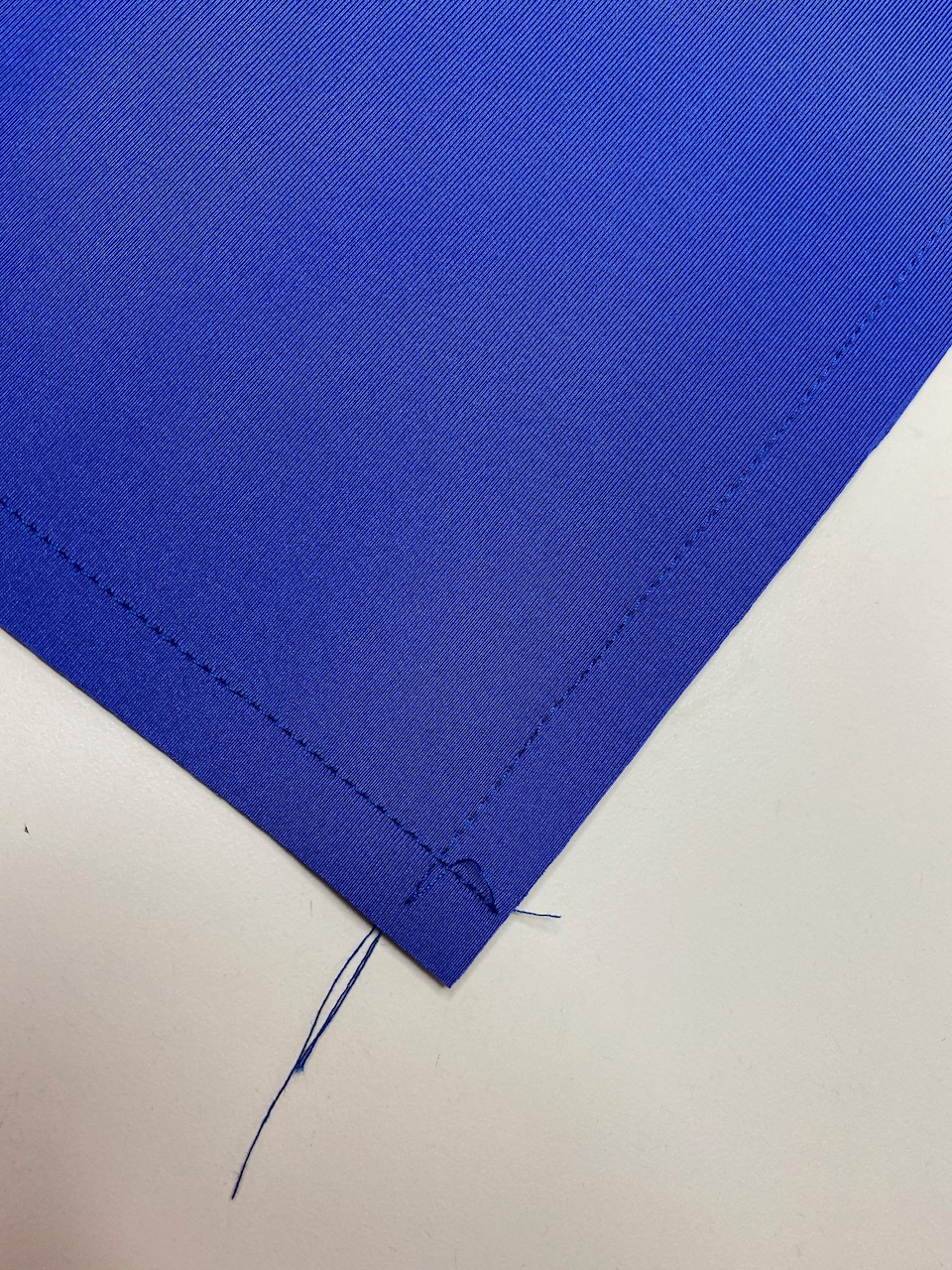

Stitch right past the end - no pivoting - and then start stitching from the other side.


Then clip the corner.


Now the part that gives you the crisp corner.  It's all in how you fold the seams inside.  I turn the garment right side out.  I fold up one seam, and then fold the other on top of the first.  A tiny poke of the corner finishes the process and I have a crisp corner - as soon as I do some understitching!

Understitching

Understitching makes pressing so much easier and when you're dealing with a fabric like scuba, it is such a help!   I wasn't able to get right into the corners or the back of the collar because it was produced by the burrito method, but I understitched where I could.


So what is understitching?  It is attaching the seam to the inside of the garment.  With the Metra Blazer, at the bottom of the front, I stitch the seam to the inside - the lining.  I fold the seam away from the outside and stitch close to the seamline.  

But then when you come to the collar, you have to reverse this because now the lining is showing on the outside.    What understitching does is make pressing so much easier and it makes a seam lie the way you want it to.  So let's take a closer look at the understitching on my Metra Blazer.  You can click on any picture to make it bigger.


With the bottom corner flipped back you can see the understitching - you can't get right to the corner but you can get pretty close.


It continues up to the break for the collar. 


After the break, I have to switch my understitching to the other side so that the stitching is hidden under the collar.


And when everything goes back to the way the Metra Blazer will be worn, the understitching doesn't show, but helps so much in the finish of the garment.  And look at that corner! Now instead of understitching I could have topstitched, but I decided that I preferred my blazer without it.

When I helped test the Metra Blazer, my first version was also made with fabric from Discovery Fabrics.

I used their Yoga Stretch for version one and did the lining and welt in Margarita Pink so that the lining would show on the lapel of the collar and contrast with the dark grey of the rest.  Just another way you can change up your Metra Blazer.

Surprisingly easy to make, the Metra Blazer is an excellent addition to any wardrobe.  Shawl collar or wide collar and lovely big pockets with a professional finish, it's a blazer that you'll love to make and be proud to wear.  You can get your copy through my affiliate link below.

Love Notions Metra Blazer sizes XS to 5X


Friday, 12 February 2021

Prisma becomes Rosie!


Pattern - Love Notions Prisma for girls
Skill Level - Confident Beginner
Fabric - cotton/spandex from l'oiseau fabrics
Skills - colour blocking, stripe matching


My friend's granddaughter is a voracious reader (actually "listener"!) and has an amazing imagination - you never know who she actually is from day to day.  Her mother told me that she's enjoying the series about Rosie Revere the Engineer and asked if I could make her a Rosie dress for her upcoming birthday.


As I was not familiar with that reading series, her mother sent me a picture and right away I could see that Love Notions' Prisma would be absolutely perfect!  And since mother was taking care of the head scarf, all I needed was white, black and red knit fabric.

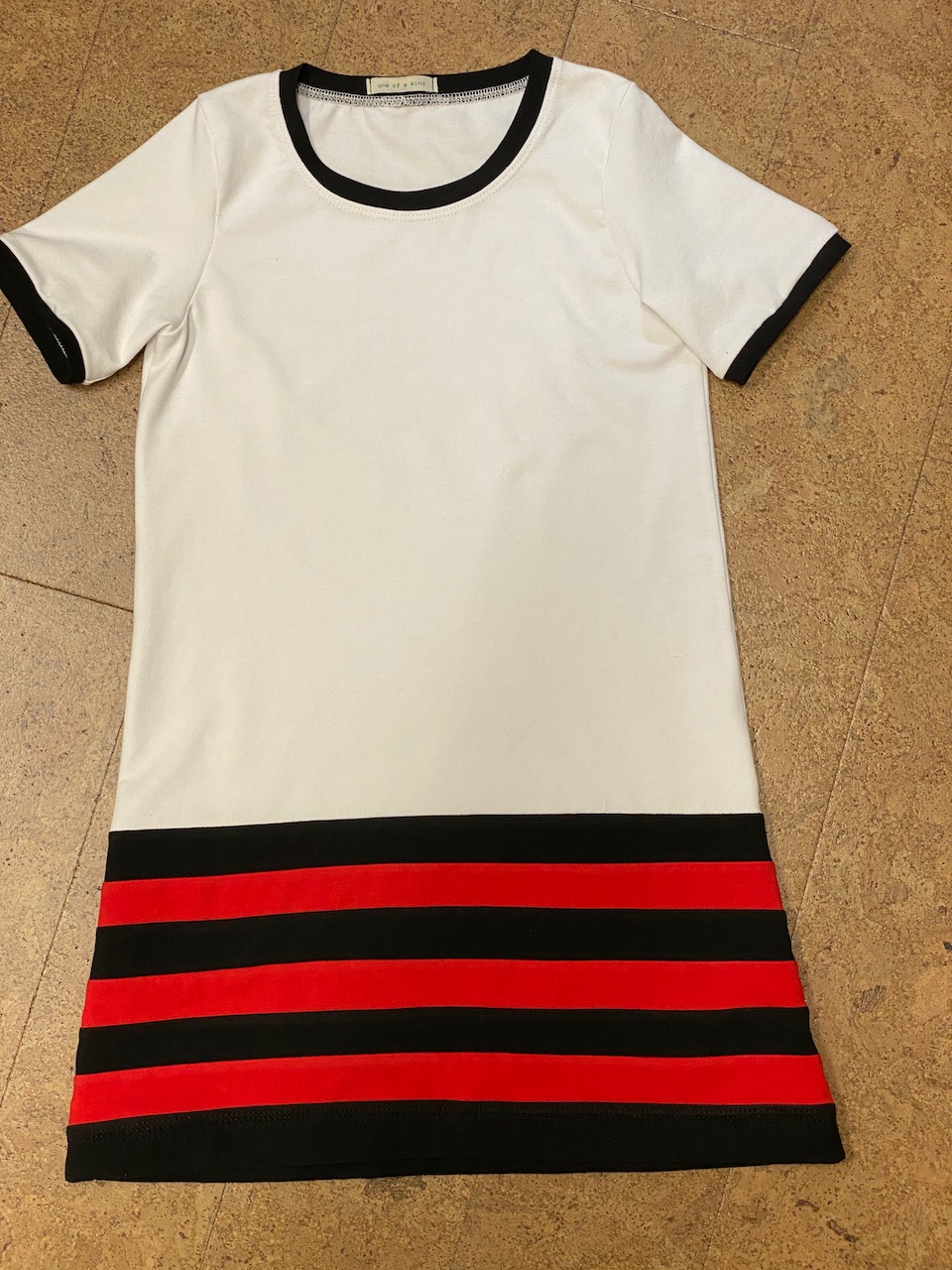
Rosie's dress is very plain with black trim at the neck and sleeves but with alternate black and red stripes at the bottom of the dress.  Now that part would need planning!


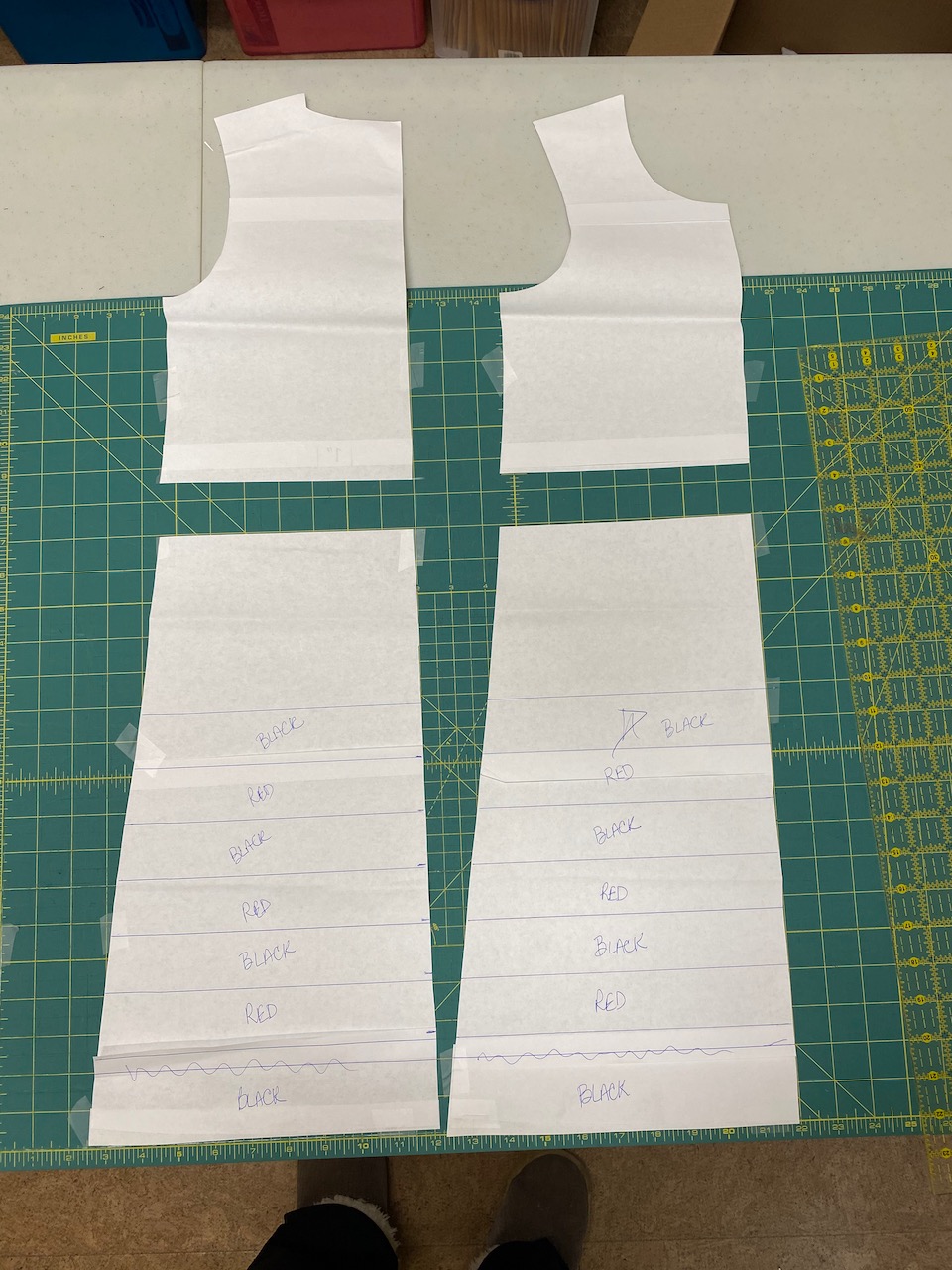
I decided on 1" stripes joined with .25" seams so each stripe would be 1.5" wide.  The bottom black stripe would be 2" wide to account for the hem.  And then I would have to add 1.5" to the body above the stripes to account for the loss that the seams cause.  I taped the pattern pieces to my cutting mat and drew lines for the stripes, then cut for the addition to the body.  I was careful to write the colour on each stripe.


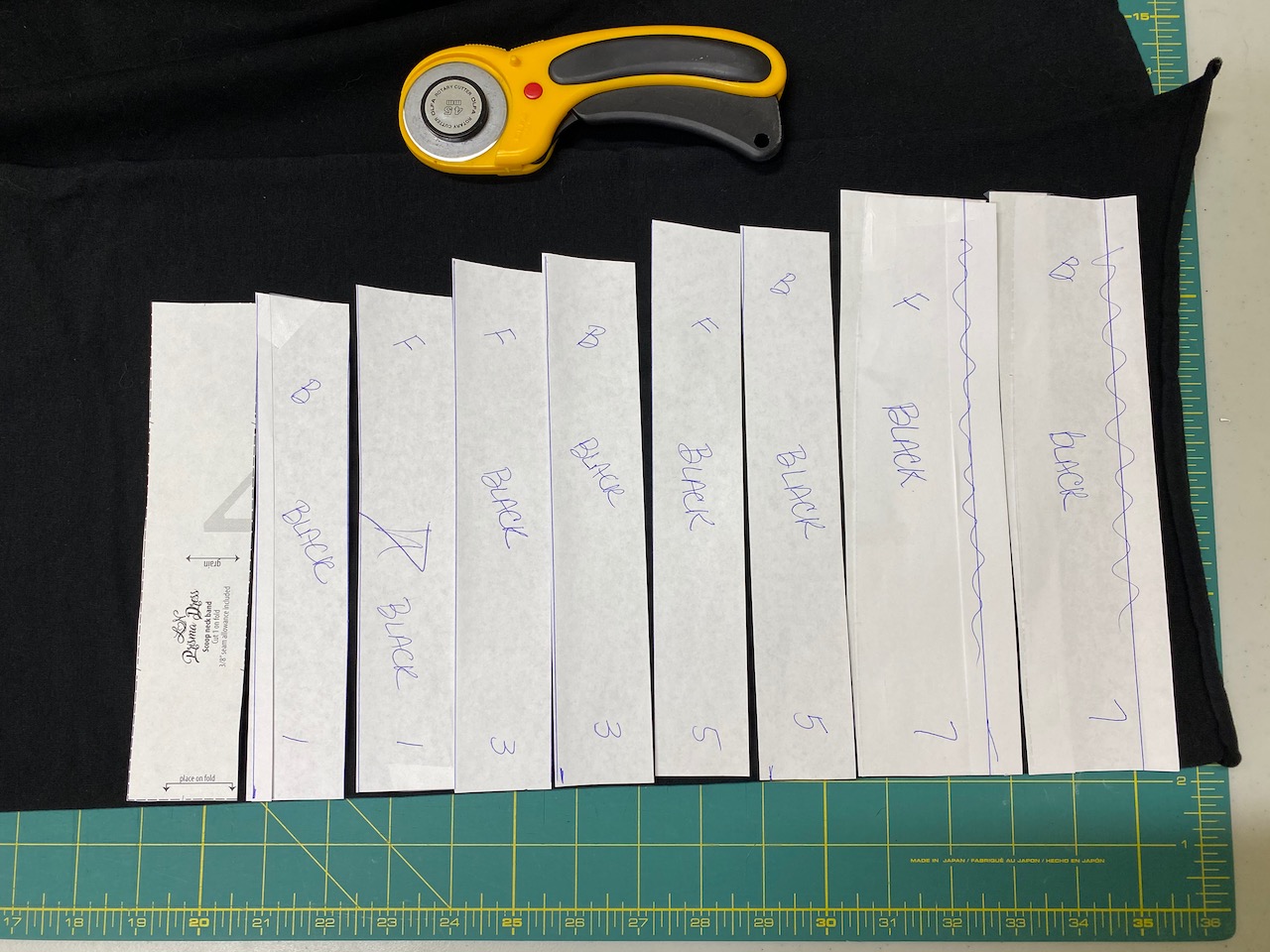
I also marked the stripes with numbers and F and B for front and back.  The Prisma version I was sewing is the A-line view, so all of the stripes would be different lengths and the outsides would have a slight slant to them.  I also made the hem straight instead of the slight curve to simplify things.


Then I placed all the pattern pieces with their fabrics.


Time to cut everything out.  The stripes were easy to cut - one at a time, starting with the largest and using the straight side of the previous cut for the next one.


Once everything was cut out, I placed all the pieces in their respective task.


I started with the stripes, going from bottom up and now you can see why numbers were important!  I serged the stripes together with a .25" seam.  And as I serged on each stripe, I steam pressed the seam down.


It's easy to get confused when sewing the stripes together (ask me how I know!) so here's a tip.  You are sewing the long side of the shorter strip to the short side of the longer strip.  When you do that, you should see a triangle of the stripe on the under side.


With all the stripes serged together, then they were serged to the body.  Now it was time to assemble the dress.


Front sewn to back and sleeves in place, the side seam needs to be sewn.  This is the tricky part!  I carefully pinned front to back and then with a longer stitch, sewed the striped section together with my sewing machine to make sure the stripes stayed put.

I did the rest of the assembly with my serger, but when I got to the striped section, I made sure the serging line was just outside of the straight stitching line.


A steam press and we're ready for the final bits - neckband, bands for the ends of the short sleeves and hemming.


I'm pretty pleased with how well it turned out and I hope "Rosie" likes it too!  Since it's a birthday present, I don't have a modelled photo, but if I get one, I'll update this post.


One final touch - a label which I purchased from Love Notions - which seemed totally appropriate!

If you don't already have this wonderful pattern for girls, you can get it from my affiliate link below.

Love Notions Prisma Dress sizes 2T to 16


Monday, 19 October 2020

Breckenridge Henley


Pattern - Love Notions Breckenridge Henley
Skill Level - Confident Beginner
Fabric - Cotton/spandex French Terry and jersey from l'oiseau fabrics
Skills - pattern marking, machine sewing buttons


Love Notions' newest pattern is the Breckenridge Henley.  As always, options, options, options!  Shirt, tunic and dress lengths as well as short and long cuffed sleeves, plus a rolled tabbed long sleeve option.  

The fabric suggestions are light to medium weight kits with at least 40% stretch.  I chose to make mine with cotton/spandex French terry from l'oiseau fabrics with the cuffs and neckband in cotton/spandex jersey.  This pattern is relatively simple once you get the neckband on and of course there's a video to help you with this step.  And naturally I have a few tips for you to help make it easier!

Marking

I can't stress enough how important marking is.  Make sure you transfer all marks to your pattern pieces.  I like to use long quilting pins with coloured heads.  I always use green ones to mark the backs of sleeves and white to mark the fronts and I do the same for the armscye markings.  That way, I never risk putting a sleeve in backwards.

I did the same for the neckband


I matched the pin colours on the band and the bodice front.  There are so many marks on these pieces you can see that it makes the job so much simpler when you have a quick reference to guide you.

Sewing on Buttons by Machine

It took me a long time to get brave enough to try sewing on buttons with my sewing machine.  Now I wonder why I waited so long!  Sewing with a needle and thread always took forever and cramped my hands up.  Once I found out how easy it is, I went out and bought a special foot for my machine, but you can do it without that and I'll tell you how later.


The first thing you need to do is position your buttons.  I pinned the placket together in between where the buttons would go to keep it in place, then dabbed glue stick on the backs of the buttons and placed them on the placket.  Don't worry about the glue - it won't clog up your needle.  By the time you take it to your sewing machine, the glue will be mostly dry.

Now it's time to sew the buttons on.  My machine has a stitch for sewing on buttons, but if yours doesn't, I'll tell you how to get around that, too!

I place the buttons under the foot roughly positioned and drop the foot to hold it in place.  My buttons have 4 holes and I like to do them diagonally.  I put the needle in the left-most hole and then turn the wheel by hand to make sure it's going to slip easily into the right-most hole and when I'm sure I have the button positioned properly, I let the machine do the work.  I do each button once to hold it in place.  

After trimming the loose threads, I turn the front piece around and do the other set of holes.  Each button is now sewn in place with an X of thread.

And to seal the deal, I dab the back of the stitching with Fray Stop to make sure the buttons stay in place.

Now if you don't have a button foot or a button stitch, you can still sew buttons on with your sewing machine as long as it has a zig zag stitch.

Take the foot off your machine.  Put the button roughly in place and drop the post right on it.  You will need to adjust the position a bit.  

Now turn off your feed dogs and set your machine to zig zag.  You want the stitch length as short as you can do it - like 0.

Lower the needle almost to your button and adjust the width of the zig zag stitch so that the needle will go easily into both holes - turn the wheel by hand.

I do about 3 or 4 stitches for each set of holes.  You can tie off the threads at the back and trim them.  And this is where I like to fix them with a drop if Fray Stop.


The placket neckband and row of buttons really finished the Breckenridge Henley. I love that there's a beautiful V and it's not too low.  The sleeve lengths give me plenty of options to change the look up and I love that I can make it tunic and dress length as well as shirt length.  

You can get this pattern through my affiliate link below.


Saturday, 20 June 2020

Vanguard! For a Biking Shirt!


Pattern - Love Notions Vanguard Kit long sleeve tee
Skill Level - confident beginner
Fabric - Discovery Fabrics Polartec Delta
Skills - Colour blocking

My grandson is turning 9 in a few weeks.   For part of his present, he said he wanted a biking shirt with padded elbows.  I knew that I couldn't possibly make something that would give him proper protection, but my son assured me that what he really wanted was a shirt with a moto look.
- like the Moto Maxx pants I'd made him the previous year.  Okay - that I can do! (Click on any picture to see it in more detail.)

The Fabric

I had the perfect fabric on hand.  He loves athletic fabrics and Discovery Fabrics specializes in athletic fabrics.  I had 3 colours of Polartec Delta sitting on the shelves - marine blue, apple green and grey - and decided to use them all.
Polartec Delta is a wonderful fabric and I had previously used it to make competition shirts for my son and his training partner.
It's highly breathable, has superior wicking properties, regulated drying, reduced clinging, odor control and is highly durable.  You can see from the picture above that it's also constructed to pull moisture away from your body. Just what my hot-bodied grandson needs.

The Pattern

The Vanguard Kit is one of my most-used patterns.
There are all kinds of options built right in - even colour blocking.  But the colour blocking I had in mind, I was going to have to figure out myself.

Colour Blocking

I drew up and coloured a design of what I had in mind and then printed off and cut out the plain fronted shirt with long sleeves.
Then I drew lines on the pattern pieces and wrote the colour on each section also making a note of where I would have to add 3/8" for seam allowance.  I cut double the middle grey sleeve sections, because it was going to have moto stitching on it.  That was going to be the padded portion.
After cutting the colour block sections, I placed each colour with its fabric.  I was ready to cut out.
I didn't add a seam allowance as all my lines were going to be straight.  I used my ruler as the guide to add the seam allowance.
You can see on this piece that the seam allowances are all there.

Sewing

I worked on the front first.
I laid all the pieces out in order and working from the bottom up, pressing the seam allowance up (and I used a pressing cloth so the fabric wasn't damaged) and topstitched as I went.  The diagonal blue section was added last and topstitched.

Then on to the sleeves.


I laid them out just as I did with the front with the grey section being two layers, pressing the seams up and topstitching.

For the moto stitching, I drew lines with tailor's chalk.
I stitched the lines on my coverstitch machine.  I could have used my regular sewing machine, but I wanted this section of the sleeve to have lots of stretch.  I used a notch on my foot as my guide in stitching.
So here is what the sleeve looks like front and back.
Now with all the piecing done, all I had to do was sew up the pieces, put on the neckband and hem.  Sounds like a lot of work, but it only took me a morning.  I know my grandson will love his new biking shirt.  He loves this fabric and he'll appreciate all the amazing properties which will keep him cool and dry while he's out on the mountain biking trails.  If you don't already have this pattern, you can get it from my affiliate link below.  And do check out Discovery Fabrics for all the amazing products they carry.

Love Notions Vanguard Kit
Discovery Fabrics