Showing posts with label understitching. Show all posts

Wednesday, 24 February 2021

The New Metra Blazer in Scuba!


Pattern - Love Notions Metra Blazer
Skill Level - Intermediate
Fabric - Mid-Weight Scuba from Discovery Fabrics
Skills - marking wrong side, crisp corners, understitching, pressing


The new Metra Blazer from Love Notions looks challenging but it's surprisingly easy.  As usual, there are videos to help you.  Two collar choices offer a shawl collar and a stylish wide one.  The star of the show is the roomy pocket with its clever welt finish - who knew a welt pocket could be so easy!  And the burrito roll method gives you a lovely clean inside front.  It comes with a full bust option for those with a difference of 4" or more between high and full bust measurements and sizes XS to 5X.  What more could you want!

Of course I have to pass along some hints in my blog posts!

When it's hard to figure out which is the right side...

Discovery Fabric's Mid-Weight Scuba is amazing stuff.  It's made in Italy by Borgini and is positively delicious to cut and sew.  My scuba was a colour called Clematis - a lovely royal blue.


My big problem was trying to decide which was the right side since both sides looked the same to me - even under a magnifying glass!  I finally decided to pick one side as the right side and mark the other side with tailor's chalk for consistency.  

Since a lot of the stitchery was going to be with my sewing machine, I did some sample stitching and to my dismay, I got skips!  Okay - I was using a universal needle, so I switched it with a stretch needle and all was fine.

Steam Pressing

Since Discovery's solid colour Mid-Weight Scuba is 80% nylon and 20% elastane, you can't press right on the fabric.  Steam pressing while you're sewing is important so using a pressing cloth and a clapper is the way to go.


First, I steam pressed over a pressing cloth.  The cloth allows me to keep the iron on a little longer and really get the steam down into the fabric.


Then I quickly lift off the iron and pressing cloth, and put on the clapper.  My husband made mine from maple but you can buy them.  They provide a little weight and keep the steam in place, giving you a sharper finish.  With a fabric like scuba, they're invaluable.

Sharp Corners

Something else I was concerned about with scuba was getting a sharp corner on the bottom of the front, but a couple of the testers taught me a clever way to get that.
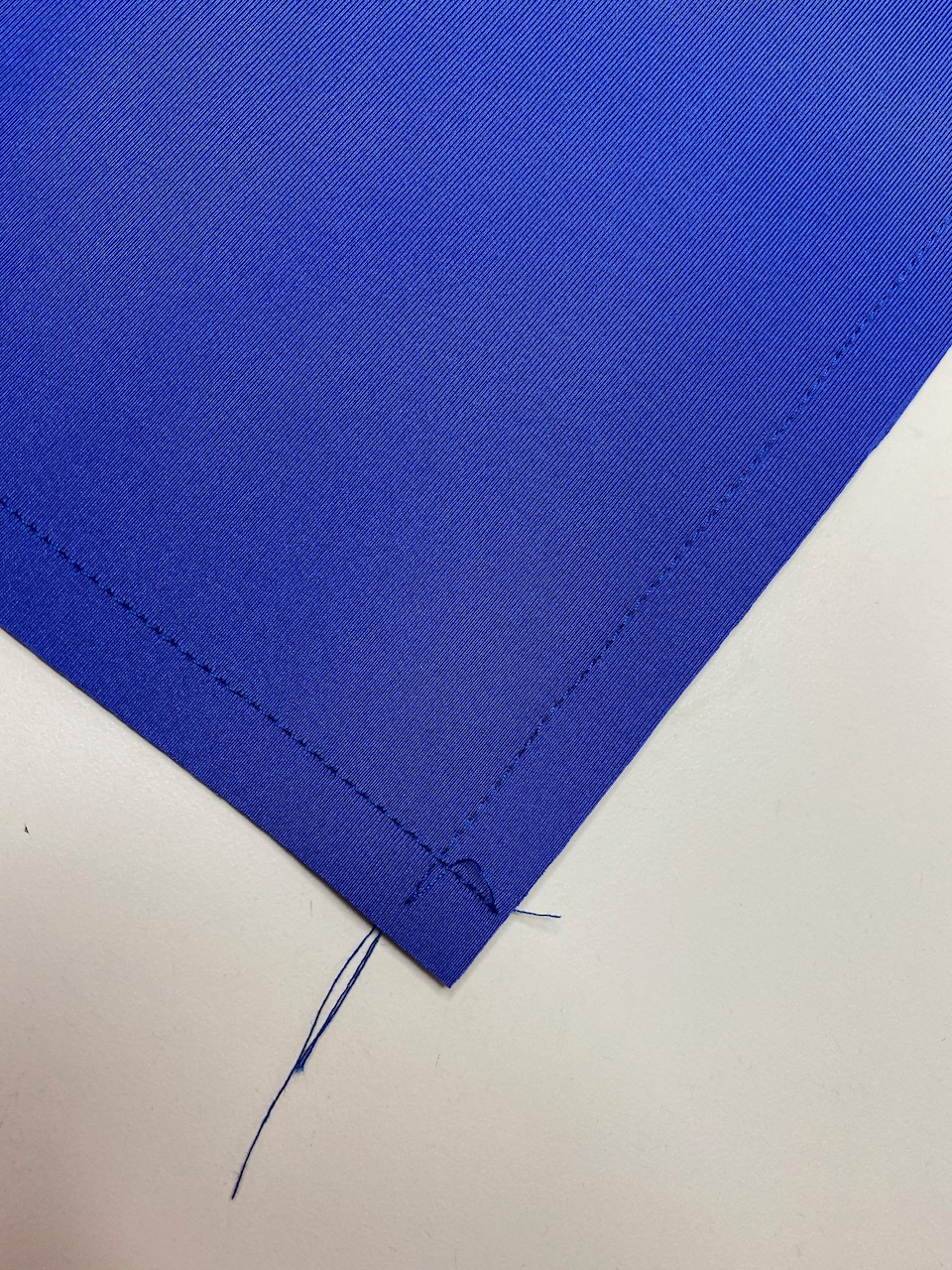

Stitch right past the end - no pivoting - and then start stitching from the other side.


Then clip the corner.


Now the part that gives you the crisp corner.  It's all in how you fold the seams inside.  I turn the garment right side out.  I fold up one seam, and then fold the other on top of the first.  A tiny poke of the corner finishes the process and I have a crisp corner - as soon as I do some understitching!

Understitching

Understitching makes pressing so much easier and when you're dealing with a fabric like scuba, it is such a help!   I wasn't able to get right into the corners or the back of the collar because it was produced by the burrito method, but I understitched where I could.


So what is understitching?  It is attaching the seam to the inside of the garment.  With the Metra Blazer, at the bottom of the front, I stitch the seam to the inside - the lining.  I fold the seam away from the outside and stitch close to the seamline.  

But then when you come to the collar, you have to reverse this because now the lining is showing on the outside.    What understitching does is make pressing so much easier and it makes a seam lie the way you want it to.  So let's take a closer look at the understitching on my Metra Blazer.  You can click on any picture to make it bigger.


With the bottom corner flipped back you can see the understitching - you can't get right to the corner but you can get pretty close.


It continues up to the break for the collar. 


After the break, I have to switch my understitching to the other side so that the stitching is hidden under the collar.


And when everything goes back to the way the Metra Blazer will be worn, the understitching doesn't show, but helps so much in the finish of the garment.  And look at that corner! Now instead of understitching I could have topstitched, but I decided that I preferred my blazer without it.

When I helped test the Metra Blazer, my first version was also made with fabric from Discovery Fabrics.

I used their Yoga Stretch for version one and did the lining and welt in Margarita Pink so that the lining would show on the lapel of the collar and contrast with the dark grey of the rest.  Just another way you can change up your Metra Blazer.

Surprisingly easy to make, the Metra Blazer is an excellent addition to any wardrobe.  Shawl collar or wide collar and lovely big pockets with a professional finish, it's a blazer that you'll love to make and be proud to wear.  You can get your copy through my affiliate link below.

Love Notions Metra Blazer sizes XS to 5X


Saturday, 28 April 2018

Moving Darts - and another hint or two


Pattern - Love Notions Sonata Dress
Skill Level - Confident Beginner
Fabric - Apparel cotton from Fabricland
Skills - Adjusting a pattern

The latest pattern from Love Notions is the Sonata - the perfect dress for summer.  It's flattering, loose and yet semi-fitted with its empire waist, fits sizes XS to XXXL and comes with 4 sleeve options and 4 bodice sizes.
The attractive neckline also has a couple of options:  you can have the facing on the outside for a contrast or face simply on the inside with topstitching on the outside which is how I did mine.

And to give you the best fit - it has darts!  Darts are what give the Sonata its shape.  And just as it's important to match your full bust to a pattern's bust line, it's equally important to make sure the darts fit your unique shape.

The first time I had to move a dart I was pretty nervous!  However after doing a few I feel a lot more confident.  Plus I was surprised at how easy it actually is.  So here are the adjustments I had to make so that my bodice fit my shape.

The first thing I had to do was establish that the bodice was going to be long enough for me.  Love Notions patterns are drafted for an average height of 5'5" and I'm 5'8".  The bodice is supposed to come to about 1" to 2" above the natural waist.  After holding the piece against myself and seeing that I was going need a little more length as well as having to move the bust dart down, I decided I needed to add 1" above the dart.

I placed the pattern piece on my cutting mat, lining it up against a vertical line and taped near the bottom.  Using my rotary cutter and rule, I sliced across the bodice, moved the piece up 1", keeping it lined against that vertical line and taped it to the cutting mat.  Taping it to the mat ensures that my pieces aren't going to move on me.
Then I added added a strip of paper, taped it in and sliced off the extra paper.  I was ready to move the darts.

I held the adjusted front bodice against my body so that it was about 3/8" over the shoulder seam of my top and lined up against the middle of my body.
Using a pencil, I marked my apex - that's the most prominent part of my bust - usually the nipple.
Apex marked, I could now plan out the movement of the darts.  I could see that I was going to have to move the bust dart down about 1.5" and the waist dart would need to be lowered about the same amount and moved slightly to the right.  Tami's clear instructions in her patterns are what gave me the confidence to make my adjustments so I followed her directions.
First I cut a box around the bust dart and moved it down so that it was pointing to my apex and just slightly above it - as it had been to the pattern's apex.  I taped it in place and filled in the open spot with scrap paper.
Now it was time to move the waist dart.  It only needed to be moved slightly to the right but it needed to be lowered 1.5".  First I established the new point and drew legs to that point.
Then I cut out the dart and moved it slightly to the outside filling in the open spot with scrap paper and trimming the edges.
And that's all there is to it!  I now had a bodice front that matched MY shape!  If darts have you concerned, don't be worried.  They're surprisingly simple to move.  And isn't that just the most amazing thing about being able to sew your own clothes?  You finish up with something that fits YOU!

Now another couple of hints to help make your sewing experience as easy as possible. Since I was planning on sewing my facing to the inside of the bodice, I serged around the outside edge of the facing.  After stitching it in place and clipping the curves, I understitched around the neckline - except for the V.  If you're not familiar with understitching, check out the blog post before this which explains it fully.  Understitching makes it so much easier to turn the facing to the back and not have any of it showing.
I used that serging line as my guide for the topstitching.  Lots of pins held the facing in place and I simply did my topstitching from the wrong side in the centre of the serging line.
Love Notions' Sonata is a great pattern to try out these tips.  You'll get a lovely dress that takes you into summer and one that is uniquely adapted for you.  And if you need any further assistance, you know that we are always ready to guide you on the Love Notions Support Group in Facebook. You can get the pattern through my affiliate link below.

Love Notions Sonata Dress

Monday, 9 April 2018

To Understitch Or Not?

I didn't enjoy high school sewing - it was basic and boring and I dropped out as soon as I could!  However, sewing is in my blood - my grandmother was a real whiz, my grandfather was a Singer dealer and genealogy showed me a long line of seamstresses in my background - so I had to give it another try.  I took sewing in night school a few years later and learned a LOT!  And one of those lessons was the importance of understitching.

So what is understitching?  It's a line of stitching close to the seamline on the facing (or bias tape) side which prevents your neckline from rolling.  It keeps that facing where it's supposed to be.  It reinforces the seam - makes it stronger and less likely to fray with woven fabrics. And it makes turning that neckline (or sleeveless armscye) just so much easier.
I wanted to see what the real differences were with necklines understitched and not understitched so I cut 2 XS necklines from Love Notions' new Harmony blouse.
It calls for a facing of 1/2" single fold bias tape on the neckline.  I was careful while stitching down the bias tape to follow the curve of the neckline - not to straighten it while sewing - as this will cause stretching and the neckline will not lie flat if this happens.  You can stay stitch the neckline before sewing on the bias tape to prevent this, but I was lazy and wanted to get the job done - so I was careful!
I stitched the bias tape to both necklines to make a proper comparison.
Next, I understitched one neckline.  I brought the seam to the facing side and stitched slightly less than 1/8" from the seamline while holding the seam to the facing side.

I took both necklines to my iron.  The understitched neckline was so much easier to iron!  Most of the work had already been done for me by the understitching.  The other neckline took more work to make sure that the facing didn't show.  It seemed to me that the understitched one also lay flatter.
Finally, I topstitched both necklines.  (And wouldn't you know - I ran out of thread while topstitching the understitched one!) The understitched one on the right definitely lay flatter.
After ironing, both necklines lay flat, but I could see where a bit of facing was peeking up on the non-understitched one and the neckline wasn't as smooth.
Conclusion?  If you want the neckline to be as trouble-free and smooth as possible, definitely take a little time and understitch it!

And want to try your hand at understitching?  Love Notions has a couple of great patterns that are easy to sew and you can use my affiliate links below to get them if they aren't already in your inventory.

Love Notions Harmony Blouse
Love Notions Cadence Dress & Top

Sunday, 30 July 2017

The Cadence - tips and tricks


Pattern - Love Notions' Cadence
Skill Rating - Confident Beginner
Fabric - Fabricland - linen/rayon blend, 100% polyester & light cotton in pictures
Skills - darts, understitching, stitching in the ditch, hemming for slits

Love Notions has done it again!  A lovely, easy dress and shirt for the summer heat that is so quick to make up that it almost rivals the Laundry Day Tee for a fast sew.  And as we've come to expect with Love Notions patterns - options!

There are a few new skills with this pattern, so I thought I'd go through some of them in a little more detail.  You can click on any of the pictures to see them in a larger format.

Darts

The front of the bodice has darts and if you haven't done them before, don't worry - they're not that hard!  The first thing to do is to mark them.
If the fabric I'm using is dark, I'll use tailor's chalk to make the marks and if it's light, a washable fabric marker will work well.  Actually, I didn't have a fabric marker - I used a ballpoint pen since it wouldn't show on the front anyway!  After I make the marks, I draw in the top and bottom of the dart and a line right down the middle to help me make the fold properly.
Then I fold the dart on the centre line and check to make sure my top and bottom lines are together.  I pin it in place using 3 pins to secure it.  I now have a line to follow with my sewing machine.
I start my stitching line at the side and stitch right to the point, removing pins as I go.  The line makes it easy for me to keep my stitching straight.
When I reach the point of the dart, I make sure the needle is down, then lift the presser foot and pivot my fabric right around on the needle so I'm now facing in the opposite direction.
I continue stitching down the fold of the dart for an inch or two and then cut the threads - you can tie them off if you like.  Press your darts down and you're done!

The Facing - Finishing the Raw Edge and Understitching

The Cadence has a facing.  If you're doing the tank version, the facing goes on burrito style and there are clear instructions on how to do this.  I did the sleeved version, so the neck facing gets handled a little differently.
After the front and back facing have been sewn together, it's time to finish off the raw edge.  I serged around the edge just next to the blade so I didn't lose any fabric, but if you don't have a serger, there are basic edge finishing stitches most sewing machines have that will do the job just as well.  I find the middle of the front of both the bodice and facing and mark it with a pin.  The facing goes on right sides together, matching the shoulder seams, centre back and centre front and then is stitched in place with a sewing machine.
I clip the curved seam about every inch or so.  This is an important step as there will not be enough ease in the seam if you don't.
Press the seam towards the facing.  I can't stress enough how important ironing is when sewing.  I'm one of those people who hates ironing, but I never skimp on ironing while sewing.
Now you're ready for understitching.  This serves two purposes.  It makes the facing stay on the inside of the neck giving you a clean sharp finish and it reinforces the seam against fraying.  With the facing on one side (and the seam underneath it) and the bodice on the other, stitch on the facing about 1/8" from the seamline.  Hold the bodice and facing apart as you stitch.  When you're done, give it another good press.  The understitching makes this part easy.  If you're doing the neckline with the vee in the middle, you won't be able to understitch that section.

The Facing - Stitching in the Ditch

We've all dealt with a facing that kept popping out at one time or another.  There's a quick and easy way to stop this from happening.
Pin the facing in place at each shoulder seam.  Make sure your bodice and facing shoulder seams are right on top of each other.  With the right side out, position your sewing machine needle right in the seamline and outside of the facing.  Slowly and carefully stitch down the seamline for an inch or two.    You don't need to stitch to the neckline.  This keeps the facing where it's supposed to be and is barely visible.
You can do the same with the back seam or you can tack it in by hand.  If doing it by hand, grab the end of the facing with your needle and tack it to the edge of the seam.  Now give it another good press and this is done!

The Slit - Hemming

The Cadence includes a shirt length with side slits (which, unfortunately, don't show in the above picture!) I did a blog post on how to prepare pattern pieces for slits with the Allegro Maxi Skirt so you can refer to that for how to serge corners.  I'm going to concentrate here on the hemming process.
The angled top of the facing piece makes it much easier to serge the raw edge.   You can see how the serging is done by clicking the link just above. After you sew your front and back seams together - raw edges serged to finish the pieces, press the seam open, and press the slit openings as well.
There are clear instructions on the pattern tutorial for how to hem the slit.  I approach it from a slightly different angle as I prefer the folded opening on the bottom where it will be less visible.  This method makes it easier for me to ensure that the slits match exactly.  I fold open the slit facings and pin up the hem 1"
Now I fold back the facing - see how it's not even with the bottom of the hem?  Time to make a slight adjustment.
I tuck the offending edge back up and pin it firmly in place.  Then I press the hem well.
Now it's time to put in marker pins to show me where to pivot my needle.  I start with a point 1/2" above the end of the seam and place a pin there.  The angled corners are also marked with a pin.
I also place pins at pivot points where I turn from the hem to the slit and from the slit to the hem.
Now to stitch.  I start at one seam, stitch to the pivot point, then down to the hem, pivot and then on - keeping a little over 3/4" from the edge.  A nice crisp hem, edges of the slit perfectly matching and with the opening of the fold facing down where it can't be seen.
From the inside, it will look like this.
And as it happens, the Cadence blouse (with 3/4 flared sleeve) looks pretty nice over the Allegro Maxi Skirt!  You can get the patterns here:

Love Notions' Cadence - Dress and Shirt
Love Notions' Allegro - Maxi Skirt